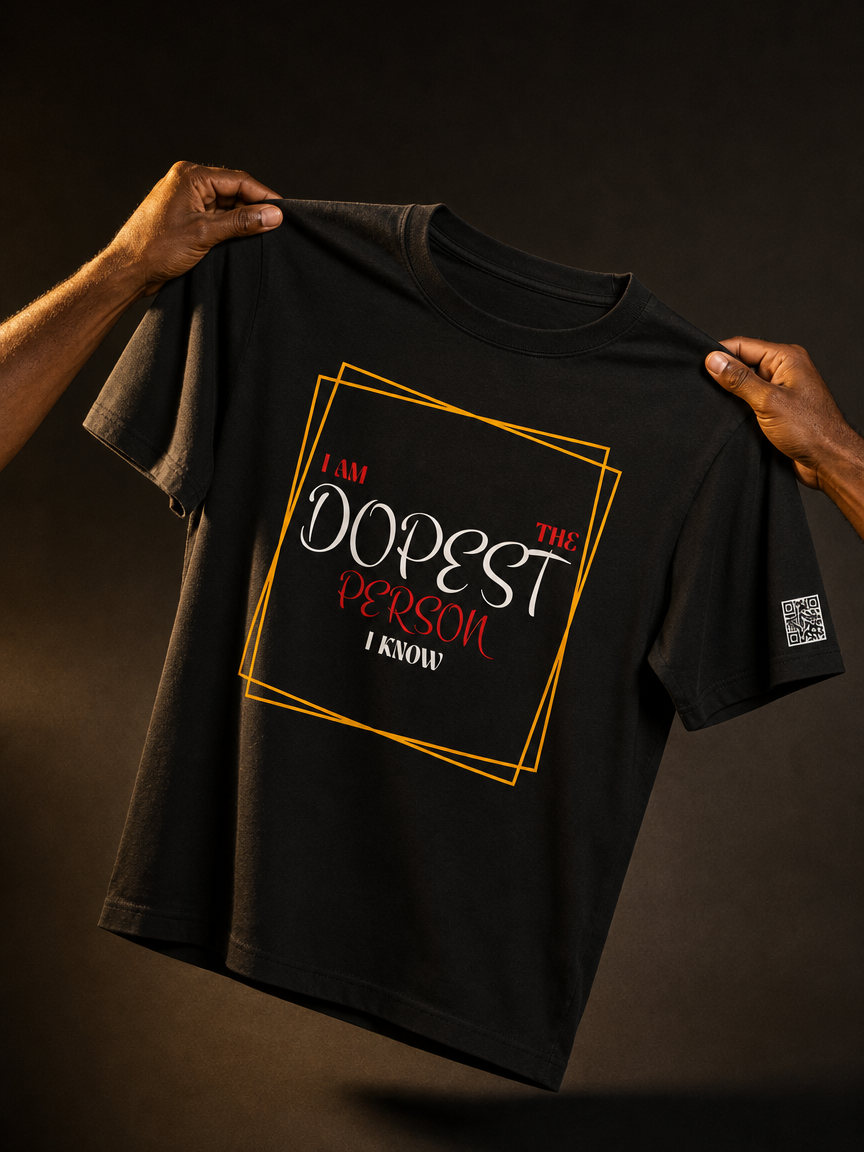
Dopest Black Unisex Graphic Tee - Affirmation Apparel by Sawubona Life
What QR Code Clothing Designs Actually Are
Sawubona, we see you. At Sawubona Life, we believe clothing should honor your presence and affirm your worth. One way brands are doing this is through QR code clothing designs, which embed scannable codes directly into apparel as both functional tools and design elements.
A QR code on a garment is a square, pixelated pattern printed onto fabric that links to digital content, for example, when scanned with a smartphone camera. These codes can be placed on sleeves, tags, labels, or anywhere on a garment's surface. Unlike traditional tags that are often hidden, QR code clothing makes the link visible and intentional.
The codes work because they're machine-readable. A phone camera recognizes the pattern and directs the user to a URL. That destination could be product information, care instructions, a brand story, or a mindfulness tool. For conscious brands, it's a way to add meaning to the garment itself.
Pro Tip: QR codes on clothing work best when they're printed with high contrast and proper sizing. A code that's too small or faded won't scan reliably, defeating the purpose entirely.
The Performative vs. Practical Question
Here's where the real conversation starts. Are QR code clothing designs genuinely useful, or do they exist mainly to signal that a brand is innovative and conscious?
Performativity means doing something primarily to be seen doing it, rather than for the actual utility. A QR code on a shirt could be performative if it's there to look tech-forward without delivering real value to the wearer. Or it could be practical if it solves an actual problem, like helping someone access care instructions, verify authenticity, or connect to a wellness resource.
The answer depends on execution. A poorly placed, hard-to-scan code that links to a generic landing page? That's performative. A thoughtfully designed code on a sleeve that connects to mindfulness content or product transparency? That's practical. The difference lies in whether the code serves the wearer's actual needs or just the brand's image.
Most garments with QR codes fall somewhere in the middle. The code exists. It works. But does the wearer actually scan it? And if they do, does the linked content feel valuable to them, or like a marketing interrupt?
Key Takeaway: The true test of whether a QR code on a garment is performative is simple: Does it serve the wearer's needs, or does it primarily serve the brand's desire to appear innovative?
Real QR Code Clothing Examples and Use Cases
The fastest way to judge whether a QR code on a garment is performative is to look at what the code actually does. Below are the common use cases, sorted by how much real utility they tend to deliver, plus the failure modes that turn each one into theater.
Care instructions and laundering guidance (high utility). Instead of cramming washing symbols and tiny text onto a tag, the code links to a video or step-by-step guide for a delicate fabric, a wool sweater, or a technical jacket. This is practical because the information is specific, time-sensitive, and hard to fit on a physical label. It becomes performative when the linked page is a generic "how to care for your clothes" article that has nothing to do with the specific garment.
Product information, materials, and authentication (high utility, if specific). A code can link to the fiber composition, country of manufacture, dye process, or a verification page that confirms the item is genuine. This is genuinely useful for resale, for allergy-sensitive shoppers checking fiber content, and for buyers who want supply-chain transparency. It turns performative when the destination is a brand manifesto rather than facts about the item in your hands.
Reorder and restock links (moderate utility). A code that lets a wearer reorder the same item in a new size or color removes friction. It is practical when the SKU is stable, and the link resolves to the exact product. It is performative when the product has been discontinued, or the link dumps the user on a homepage.
Social media, campaigns, and promotions (low utility to the wearer). A code that opens a discount, an exclusive playlist, or a campaign page primarily serves the brand. That does not make it worthless, but it is the clearest example of a code that exists to be seen. The wearer gets little unless the reward is real and immediate.
Mindfulness and mental health anchors (utility depends entirely on the content). A subtle sleeve code that opens a grounding exercise, an affirmation, or a crisis resource can be a private, personal tool. It becomes performative when the content is thin, when the code is placed where no one can scan it discreetly, or when the brand uses the code mainly as a marketing story rather than a functioning resource.
Inventory and internal operations (utility to the brand, not the wearer). Codes used for warehouse tracking, authenticity checks at retail, or rental-return processing are practical for the business. They are not performative, but they are also not a feature the wearer asked for. Do not market them as one.
A useful rule of thumb: if the code disappeared tomorrow, would the wearer lose something they were actually using? If the answer is no, the code is decoration. If the answer is yes, it is a feature.
Key Takeaway: Sort every QR code use case into two buckets: what the wearer gains and what the brand gains. When the wearer's bucket is empty, the design is performative regardless of how clever the placement looks.
How to Make a QR Code Shirt: A Practical Framework
Creating a QR code shirt involves several steps, from deciding what the code links to, all the way through testing and production.
Step 1: Define the destination. What should the code link to? This is the most important decision. It could be product care, a landing page, a mindfulness tool, or authentication information. The destination determines whether the code feels useful or performative. Write this down first.
Step 2: Choose your QR code type. Static codes link to a fixed URL and can't be changed after printing. Dynamic codes use a redirect service and can be updated anytime. Dynamic codes cost more but offer flexibility; you can change where the code points without reprinting the garment.
Step 3: Generate the code. Use a QR code generator (many are free online). Upload your destination URL and generate the code image. You'll get a PNG or SVG file.
Step 4: Design placement and sizing. Decide where the code goes on the garment. Sleeves are popular because they're visible but not intrusive. Size matters; codes need to be large enough to scan reliably from a phone camera. A minimum of 1 inch by 1 inch is a good starting point, though larger is safer.
Step 5: Test scanability. Print a sample on fabric and test it with multiple phones. Scan from different angles and distances. If it doesn't scan reliably, adjust the size or contrast.
Step 6: Finalize print specifications. Work with your printer on ink type, color, and contrast. Black on white scans best. Colors can work if there's enough contrast between the code and the background fabric.
Step 7: Run a pilot batch. Print a small run of garments with the QR code. Collect feedback. Do wearers actually scan it? Does the linked content feel valuable?
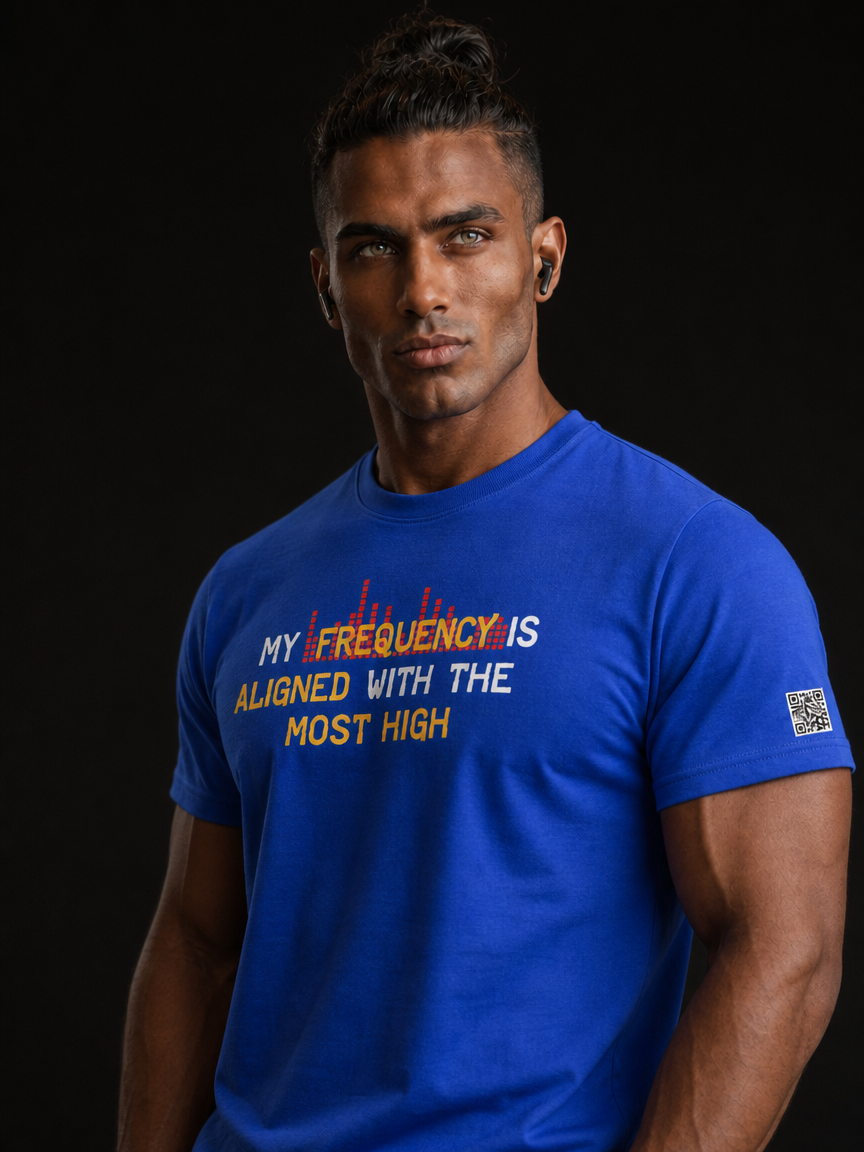
Aligned Frequency Blue Unisex Graphic Tee - Affirmation Apparel by Sawubona Life
Watch Out: A faded or low-contrast QR code won't scan. This is the most common mistake. Test your print quality before committing to a full production run. A code that doesn't work damages trust in the brand and the garment.
QR Code Design Best Practices for Apparel
Contrast is everything. The code must stand out clearly from the fabric. Black codes on light fabric work best. Avoid placing codes on busy patterns or dark backgrounds where the code blends in.
Size appropriately. A code that's too small won't scan from a normal phone distance. Aim for at least 1 inch square, preferably larger. Test different sizes before finalizing.
Place it thoughtfully. Sleeve placement is popular because it's visible without dominating the garment. Tags and labels work too. Avoid placing codes where they'll be hidden or damaged by normal wear.
Keep the destination clear. If someone scans your code, they should immediately understand where it's taking them and why. A confusing or irrelevant landing page wastes the opportunity.
Use white space. QR codes work best with a quiet border around them. A code surrounded by busy pattern or text may not scan reliably.
Consider durability. Codes printed on areas that get washed frequently or folded repeatedly may fade over time. Test your fabric and ink combination for longevity.
Printing QR Codes on Fabric: Durability and Scanability
A QR code on a garment has to survive something a paper code never faces: repeated washing, stretching, folding, abrasion, and UV exposure. The printing method matters, but so does where the code sits and how it is tested. Most practitioners find that scan reliability degrades long before the code becomes visually unrecognizable, which is why durability testing has to measure scanning, not just appearance.
Screen printing. Ink is pushed through a mesh screen onto the fabric. Plastisol inks sit on top of the fabric and hold contrast well; water-based inks soak in and can look softer but may lose edge sharpness over time. Black on white or light fabric gives the strongest contrast. Screen printing is generally the most durable option for codes that need to survive dozens of wash cycles, but heavy stretch across the print area can crack the ink and blur module edges.
Direct-to-garment (DTG) printing. A digital printer lays ink directly onto the fabric. DTG handles fine detail well, which helps with small modules, but the print sits on the surface and can fade faster than screen print under repeated washing, especially on dark garments where a white under-base is required. Expect visible dulling after a moderate number of washes depending on the ink and pretreat used.
Heat transfer and vinyl. A design is pressed onto the fabric with heat and pressure. Quick to produce, but the transfer can peel at the edges, crack along fold lines, and stiffen the area. A stiff patch on a sleeve also changes how the garment drapes, which wearers notice.
Embroidery. Not viable for QR codes. Thread cannot reproduce the precise module grid, and the resulting texture scatters light in ways scanners cannot resolve. Skip it.
Woven labels. A woven or printed label inside the garment can carry a small code, but the weave texture and the small size usually make scanning unreliable. Labels work better for a URL or a short code than for a scannable QR pattern.
Where the code sits matters as much as how it is printed. Sleeves, chest panels, and hems all move differently. A code on a high-stretch area will distort when worn, and a distorted QR code is a non-scanning QR code. A code on a fold line will crease. A code on a hem will abrade against belts, chairs, and bags. Place codes on relatively stable, low-stretch, low-abrasion panels.
A practical wash-test protocol. Before committing to a production run:
Print the code on the actual fabric with the actual ink and method.
Wash the sample according to the garment's care label, using the same temperature and detergent a customer would.
After each wash, let it dry fully, then scan from a normal handheld distance with at least two different phone models.
Log whether the scan succeeds on the first try, how long it takes, and whether the phone has to be moved closer than usual.
Repeat for at least ten wash cycles, or the number of cycles the garment is expected to survive.
Also test after stretching the fabric in the print area and after folding along the code.
If the code stops scanning before the garment wears out, the design has failed regardless of how good it looks on day one.
Contrast and lighting. Scanners rely on the difference between light and dark modules. Black on white is the safest. Low-contrast combinations, glossy inks that reflect glare, and codes printed over busy patterns all reduce reliability. A quiet zone of blank fabric around the code, roughly the width of four modules on each side, helps the scanner lock on.
Size and distance. A code that is too small forces the user to bring the phone uncomfortably close, which is awkward on a worn garment. Larger codes scan from farther away and tolerate more distortion. Test the actual size on a real garment, worn, not flat on a table.
Watch Out: A code that scans perfectly on a flat sample can fail on a worn garment because the fabric curves, stretches, and folds. Always test on a body, not just on a table.
Privacy, Consent, and Tracking Trade-offs
When someone scans a QR code on your garment, data is collected. The scanning service logs the scan, often capturing the device type, location, and timestamp.
For brands, this data is valuable. It shows how many people engaged with the garment, where they scanned from, and what they did next. But for wearers, this raises a privacy question: Should I be okay with being tracked every time I wear this shirt?
The consent issue is real. Many wearers don't realize they're being tracked when they scan a code. A transparent brand will disclose what data is collected and how it's used. A privacy-conscious wearer might choose not to scan codes on garments that don't explain their tracking practices.
Some codes are more private than others. A code that links directly to a URL (no redirect service) collects less data. Sawubona Life’s small QR code links directly to its homepage. A code that uses a redirect service or analytics platform collects more. Wearers should understand the difference.
The trade-off is real. Brands want engagement data. Wearers want privacy. A garment with a QR code that links to genuinely valuable content (care instructions, mindfulness resources, product transparency) makes the trade-off feel worthwhile. A code that exists mainly to track engagement feels invasive.
At Sawubona Life, we believe in transparency. Our sleeve QR codes link to our homepage, which features resources designed to support your mental health and self-worth. Your scan is between you and the content you're accessing.
Accessibility and Non-Digital Alternatives
Not everyone can scan a QR code. Some people don't own smartphones. Others have visual impairments that make scanning difficult. Some simply prefer not to use QR codes.
A QR code clothing design should never be the only way to access important information. If a code links to care instructions, those instructions should also be printed on a tag. If it links to product transparency, that information should be available on the brand's website without needing to scan anything.
Alternatives to QR codes include:
Printed text on tags or labels (traditional but reliable)
A website URL printed on the garment (requires typing, but isn’t accessible to everyone)
NFC tags (similar to QR codes but require compatible phones)
Printed barcodes (work with barcode readers, but are less common for consumers)
QR codes plus printed text (the best approach, offers choice)
For neurodivergent wearers or those with sensory processing differences, the physical experience of the garment matters more than digital features. A QR code shouldn't distract from comfort or create anxiety. Keep codes small and unobtrusive. Offer printed alternatives for any critical information.
Best For QR codes on garments work best for brands that offer genuinely valuable digital content, care guides, mindfulness resources, product transparency, and provide printed alternatives for essential information.
Evaluating Whether a QR Code Garment Works for You
Before buying a garment with a QR code, ask yourself these questions:
Does the code solve a real problem for me? If it links to care instructions you'd actually use, or mindfulness content that supports your mental health, it's practical. If it's just there to look innovative, skip it.
Can I scan it reliably? Check reviews or try scanning a sample if possible. A code that doesn't work reliably is worse than no code at all.
What data is collected when I scan? Does the brand explain what happens to your data? Are you comfortable with it?
Are there printed alternatives? If the code is the only way to access important information, that's a red flag. You should always have a non-digital option.
Does the garment feel like me? A QR code should enhance the garment's purpose, not dominate it. If you love the shirt's design and comfort, the code is a bonus. If the code feels like the main point, reconsider.
Will it last? Ask whether the code will fade after washing. A code that stops working after a few wears is a waste.
The best QR code clothing designs are the ones you forget about until you actually need them. They enhance the garment without demanding attention. They serve your needs, not the brand's marketing agenda.
Frequently Asked Questions
How do QR codes on clothing actually work?
QR codes on apparel function like any printed QR code: a smartphone camera scans the code and decodes the embedded data, typically a URL. The code is printed directly onto the fabric using specialized textile printing methods. When scanned, it directs users to digital content, product information, care instructions, sustainability details, or mindfulness tools. The effectiveness depends on print quality, fabric surface texture, and adequate contrast between the code and the garment background. Unlike paper codes, fabric codes must withstand washing and wear without degrading.
Can QR code clothing designs be genuinely useful, or are they just marketing?
They can be genuinely useful if designed with a specific user need in mind. A QR code linking to washing instructions, sustainability sourcing, or personalized mental health content serves real utility. However, codes that exist purely for brand visibility without a clear user benefit are performative. The difference lies in whether the linked content solves a problem your audience actually faces. Conscious brands intentionally integrate QR codes into the customer experience; others use them as novelty elements. Evaluate by asking: Does this code provide information I can’t get from a different way? Does it enhance my experience with this garment?
What should a QR code on a shirt link to?
The destination depends on your audience and brand values. Care instructions, fabric composition, and sustainability sourcing are practical choices that reduce friction for conscious consumers. Mental health affirmations, mindfulness tools, or community resources align with brands supporting personal wellness. Product reorder links or exclusive content create engagement. The best QR code destinations solve a problem or add value specific to your garment type and customer values. Avoid linking to generic landing pages or outdated content. Test the link regularly and use dynamic QR codes so you can update the destination without reprinting inventory.
How do I know if a QR code clothing design will work for my sensory or accessibility needs?
Request detailed fabric specifications before purchasing clothing. The weight, fiber content, weave structure, and finishes matter for sensory comfort. Ask whether the brand offers tagless construction, seam placement details, and whether the QR code print adds texture that might cause irritation. For accessibility, confirm the code is large enough to scan reliably and has sufficient contrast. Understand your own sensory preferences: some people find printed designs irritating, while others tolerate them well. Check the brand's return policy to ensure you can test the garment's actual feel. Real customer reviews mentioning sensory experiences are more reliable than marketing claims.
The Bottom Line: We See You
At Sawubona Life, we design every detail with intention. Our sleeve QR codes are small and unobtrusive and connect you to mindfulness resources that remind you of your self-worth, not to tracking pixels. Premium, ultra-soft, tagless apparel meets quiet advocacy. Your presence matters. Your comfort matters. Your mental health journey matters. Explore how our conscious apparel can support you every day. Shop Now and claim your everyday anchor for peace and empowerment.
WE SEE YOU.
WE VALUE YOU.
WE HONOR YOUR TIME.
Wear Your Truth Now