
A Woman Wearing a Sawubona Life White Anointed Hoodie in Her Home Office
Quick Summary
Purpose-led streetwear is clothing built around a stated mission that shapes design, materials, production choices, and how a brand treats people, not a slogan printed on a garment. To build a purpose-led streetwear wardrobe, score each brand against four tiers: stated mission, operational proof, third-party verification, and measured outcomes, then favor simple construction and durable fabric that survives repair and resale.
A slogan is a sentence, while a standard is a rule the brand follows even when it costs money.
Mark each brand tier as absent, claimed, or verified, and treat brands that cannot clear Tier 2 with caution.
Ask five questions covering fabric, makers, mission cost, complaint handling, and what the brand changed its mind about.
Repair when the fix costs less than a comparable replacement and the fabric itself is still sound.
Wash cold and less often, air dry when you can, and repair before you replace to extend garment life.
What Purpose-Led Streetwear Actually Means
Purpose-led streetwear is clothing built around a stated mission that shapes the design, the materials, the production choices, and the way the brand treats people, rather than a slogan printed on a garment. Sawubona is an isiZulu greeting that means "I see you," acknowledging a person's full worth and potential. That idea sits at the center of how we think about purpose-led streetwear at Sawubona Life, and it is a useful test for any brand you are considering.
The category has grown quickly, and with growth comes noise. Plenty of labels print a message on a garment and call it a movement. The difference between a purpose-led brand and a well-designed T-shirt with a nice font comes down to whether the purpose changes decisions the customer never sees.
Below, we break down how to read a brand's claims, what to check before you spend, and how to build a wardrobe that reflects your values without sacrificing comfort or durability.
The Difference Between a Slogan and a Standard
A slogan is a sentence. A standard is a rule the brand follows even when it costs money. Most purpose-driven clothing brands can tell you what they believe; far fewer can tell you what they refuse to do. That refusal is where purpose becomes real.
Most top-ranking articles on purpose-led streetwear stop at the slogan-versus-standard distinction and never show readers how to apply it. This section closes that gap with a four-part framework you can run against any brand in about fifteen minutes, using only published information or answers the brand gives directly.
A Four-Part Framework for Evaluating a Purpose-Led Brand
The framework sorts every claim into one of four tiers, from weakest to strongest. A brand need not score high on all four to be legitimate, but one that scores low on all four is almost certainly selling positioning rather than practice.
Tier 1, Stated mission. Does the brand publish a specific mission that names who it serves and what outcome it pursues? A mission that could be swapped onto any competitor's homepage without changing a word is a slogan. A mission that names a population, a problem, or a commitment the brand could plausibly fail at is a standard in embryo.
Tier 2, Operational proof. Does the mission show up in decisions a customer can inspect? Look for fiber content and fabric weight on product pages, named production partners or regions, care instructions that reflect the actual fabric, and product descriptions that repeat the mission page's commitments. The test is consistency: if the values appear only in marketing copy and vanish on the product page, you are looking at Tier 1 only.
Tier 3, Third-party verification. Can any claim be checked against an outside source? Certifications you can look up independently, published supplier lists, factory audits, or reporting that cites a method and a timeframe all count. Self-declared promises do not. A brand that submits to outside review is telling you it expects to be held to its word.
Tier 4, Measured outcomes. Does the brand report what its purpose actually produced? Named programs with stated frequency and recipients, impact numbers tied to dates, or honest statements about what the brand does not yet measure all qualify. The strongest signal is a brand willing to publish a number that could embarrass it.
How to Score a Brand in Fifteen Minutes
Run the framework as a simple checklist. For each tier, mark the brand as absent, claimed, or verified. A brand that reaches "verified" on Tier 3 or Tier 4 is doing work most of its competitors are not.
Absent means you could not find the information after a reasonable search of the brand's site and public materials.
Claimed means the brand asserts something but offers no way to check it.
Verified means you found specifics, a named facility, a look-up-able certification, a dated impact report, that a third party could confirm.
A common pattern is a brand that verifies Tier 2 but never reaches Tier 3 or Tier 4, likely genuine but early. Treat with caution any brand that cannot clear Tier 2, however polished its mission page looks.
What Each Tier Looks Like in Practice
Slogan behavior: a mission statement on the homepage that never appears again anywhere on the site.
Standard behavior: the same commitments repeated in product descriptions, care guides, and answers to customer questions.
Slogan behavior: vague phrases like "ethically made" with no further detail.
Standard behavior: named materials, stated fabric weights, and a supply chain the brand can describe in plain language.
Slogan behavior: an impact badge in the footer with no linked report.
Standard behavior: a dated update that states what was measured, how, and what changed.
Watch Out: a brand can be strong on Tier 1 and Tier 2 and still weak on Tier 3 and Tier 4. Do not let a well-written mission page substitute for verification you can check.
If you want a concrete example of how to apply these questions to real product details, our guide on how to shop Black-owned mindful apparel walks through the same framework with specific garments.
How to Tell a Purpose-Driven Clothing Brand from a Marketing Campaign
You can separate a purpose-driven clothing brand from a marketing campaign by asking five specific questions and listening for specifics rather than adjectives. Vague answers are the tell. A brand doing real work usually welcomes the interrogation.
Five Questions That Reveal a Brand's Real Priorities
What is your fabric, exactly? Look for fiber content and weight. "100% cotton, heavyweight" tells you something. "Premium blend" tells you nothing.
Who makes your clothes, and where? A purpose-led brand can name its production partners instead of hiding behind "our overseas factory."
What does your mission cost you? Brands that sacrifice margin for a standard will say so. Brands that treat purpose as free decoration will not.
How do you handle a complaint? Responsiveness to a fit or quality issue reveals more about values than any manifesto.
What have you changed your mind about? A brand that can name a decision it reversed is a brand that is actually paying attention.
If you want a concrete example of how to evaluate these claims, our guide on how to shop Black-owned mindful apparel walks through the same questions with real product details.
Sensory-Friendly Clothing: The Comfort Test Most Shoppers Skip
Sensory-friendly clothing is apparel designed to reduce skin irritation and tactile discomfort, typically through tagless construction, soft seams, and breathable natural fibers. Most shoppers never test for it, buying on look and price and discovering the problem after the first wash.
The comfort test is simple, and you can run it before you buy:
Check the neckline. A printed or heat-transfer label inside the collar is the single most common irritant. Tagless construction removes it entirely.
Read the fiber content. Cotton breathes and softens with washing. High synthetic content can trap heat and feel slick against sensitive skin.
Ask about seam placement. Flatlock or covered seams sit flatter against the body than standard overlock stitching.
Weigh the fabric. Heavier cotton knits tend to drape rather than cling, which matters if you are sensitive to fabric movement against the skin.
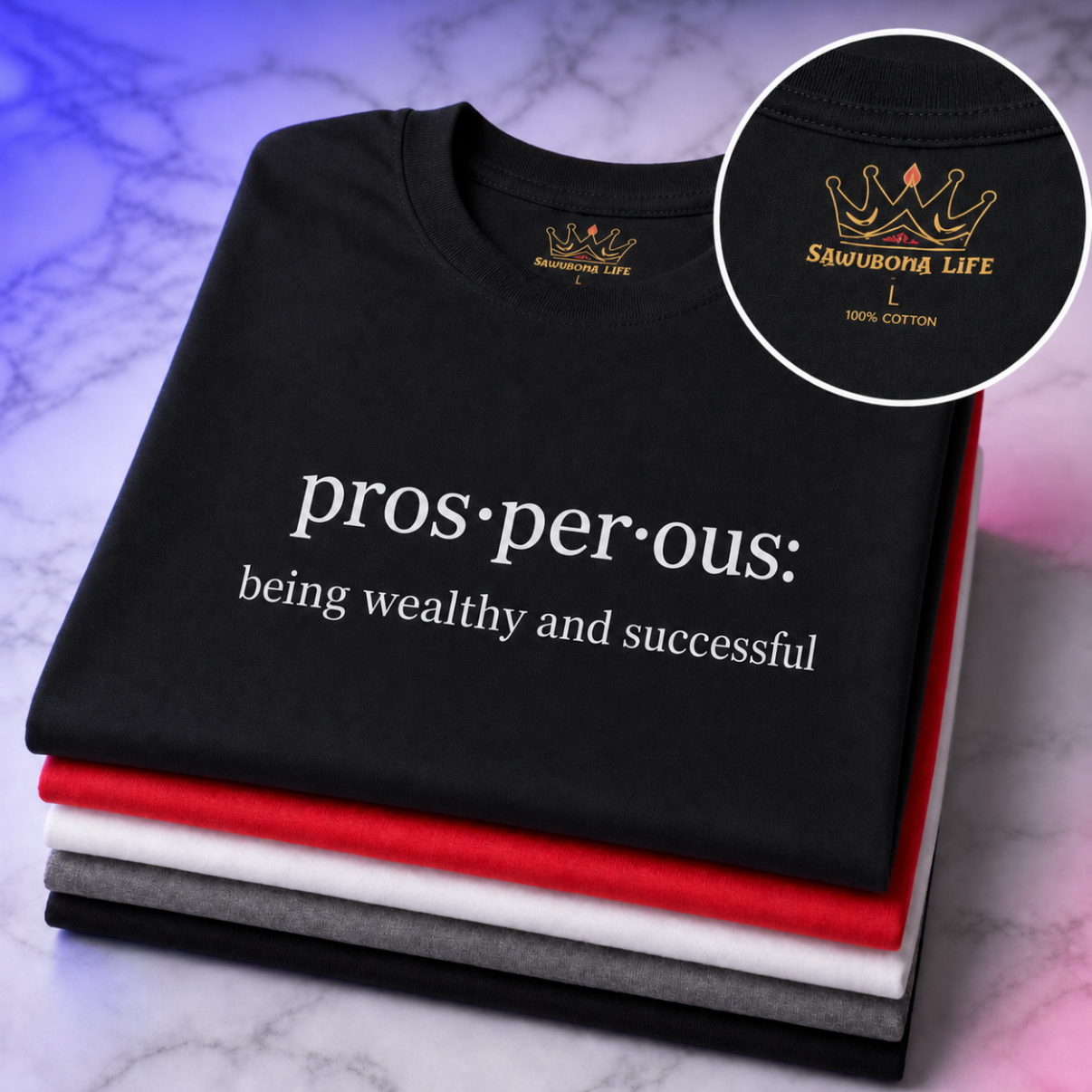
Sawubona Life’s Purpose-led Streetwear, Highlighting Soft Seams and Tagless Fabric.
A common mistake is assuming "sensory-friendly" is a regulated term. It is not. Any brand can use it. What you can verify is construction: no tag, stated fiber content, and a seam you can inspect. Our tagless clothing guide for sensitive skin breaks down how to compare fabrics, seams, and fit side by side.
Why Mental Health Awareness Apparel Belongs in Your Rotation
Mental health awareness apparel works because clothing sits closest to the body and travels through the whole day, which makes it a quiet, repeatable reminder rather than a one-time gesture. A message you wear is a message you meet again at every mirror, every meeting, every hard afternoon.
That repetition is the point. Affirmation apparel is not therapy and does not replace care, but it can function as an anchor: a small, deliberate cue that interrupts a spiral or reinforces an intention you set for yourself. The design matters less than the consistency.
We built Sawubona Life around that idea, pairing soft tagless basics with subtle sleeve QR codes that link to mindfulness tools, so the reminder is available without being loud. If you want to understand the advocacy behind the brand, our piece on supporting minority mental health awareness explains the community focus and why representation in this space is not a trend.
Best for: People who want a wearable cue toward self-worth without a billboard on their chest. Skip if: you prefer your clothing to carry no message at all, which is a completely valid choice.
Intentional Wardrobe Choices: Building a Closet That Works on Hard Days
Intentional wardrobe choices start with one question: what will I actually be able to wear on my worst day? Build the closet around that answer, then add the rest.
Most people build the opposite way, buying for the best-case scenario and discovering half the closet is unusable when energy is low or skin is reactive. A better approach is to sort by function first.
Layer one: the pieces that never irritate, never need adjustment, and never require a decision. These should be the most represented category in your closet.
Layer two: pieces that work for specific settings, like a work shirt or a heavier hoodie for cold weather.
Layer three: the expressive pieces you reach for when you have capacity.
The goal is a closet where the easy choice is also the comfortable one. If you want to see how affirmation apparel supports a mindset shift over time, our article on what you wear while you heal covers that connection in more depth.
Supply Chain Transparency and Labor Standards You Can Verify
Supply chain transparency means a brand can name the facilities where its garments are cut and sewn, and can describe the labor standards those facilities are held to. Verifying it takes more than reading a sustainability page.
Ask for the specifics and watch how the brand responds:
Named partners versus vague regions. "Our partner facility" is weaker than a named factory with a location.
Stated standards versus certifications. A certification you can look up independently is worth more than a self-declared promise.
Watch out: A common trap is the "ethical fashion" badge that appears only in a footer graphic. If a brand cannot tell you anything about where a specific garment was made, treat the claim as unverified rather than false, and factor that into what you are willing to pay.
The Federal Trade Commission's guidance on environmental marketing claims is a useful reference for how green claims are supposed to be substantiated. It gives you a vocabulary for asking better questions.
Repair, Resale, and End-of-Life: Extending a Garment's Life
Extending a garment's life is the most reliable sustainability move available to any shopper, and it costs nothing to start. The greenest shirt is the one you already own and keep wearing. Most top-ranking articles on purpose-led streetwear mention sustainability in general terms but stop before the practical lifecycle questions: what breaks first, when repair beats replacement, how resale works, and what happens at the very end. This section covers all four.
What Actually Wears Out First
Knowing where a garment fails tells you what to inspect before you buy and what to fix before it spreads. In heavyweight cotton knits, the common failure points are consistent:
Underarm and side seams take repeated stress from movement and washing. A reinforced or flatlock seam lasts longer than a standard overlock stitch.
Neckline ribbing stretches out before the body of the shirt shows wear, especially on tagless tees where the collar carries the shape.
Hems and cuffs fray from abrasion against waistbands and surfaces.
Print and heat-transfer labels crack or peel, which is one reason tagless construction removes both an irritant and a failure point.
A garment with simple construction and durable fabric is easier to repair because there are fewer specialized components to replace, the practical reason to favor heavyweight cotton and clean seams in a purpose-led wardrobe.
When Repair Beats Replacement
The decision rule is straightforward: repair when the cost of the fix is less than the cost of a comparable replacement and the fabric itself is still sound. A re-stitched hem, a reinforced seam, or a replaced collar button usually falls well under the price of a new garment, and a tailor can match heavyweight cotton knit without trouble.
Watch out: repair stops making sense when the fabric has thinned across a wide area rather than at a single seam. Patching a large worn zone often fails again quickly, and the garment has reached the end of its wearable life. Learn to tell localized wear from structural wear before you pay for a fix.
How Resale Actually Works
Resale keeps material in circulation and recovers some of what you spent, but the mechanics matter more than the idea. Three factors determine whether a piece resells well:
Recognizability. Buyers search for brands and specific styles, so pieces with a clear label and a known fit move faster than unbranded basics.
Condition. Stains, stretched collars, and pilling cut resale value sharply. Washing cold and air-drying preserves the condition that makes resale possible.
Documentation. Original tags, size labels, and accurate measurements in a listing reduce buyer hesitation and disputes.
End-of-Life Options
When a garment is truly finished, the goal is to keep the material out of the waste stream. Textile recycling programs accept worn clothing and sort it by fiber, and some brands run take-back programs for their own products.
For broader context on how apparel impact is discussed and measured, the Environmental Protection Agency's materials and waste data shows how much textile material moves through the waste stream each year, which is the backdrop for every repair and resale decision you make.
The Lifecycle Habit That Carries Most of the Weight
Three habits do most of the work, and they cost nothing to start:
Wash cold and less often. Heat and agitation break down cotton fibers faster than wear does.
Air dry when you can. Tumble drying is the single biggest driver of shrinkage and thinning in knitwear.
Repair before you replace. A re-stitched hem or a reinforced seam buys years.
If you are building a purpose-led streetwear wardrobe, favor pieces with simple construction and durable fabric, because those are the garments that survive resale and repair cycles and stay out of the waste stream longest.
How to Measure a Brand's Social and Environmental Impact
Measuring a brand's impact means looking for claims tied to a number, a timeframe, and a method, and treating everything else as narrative. The honest brands are often the ones most willing to say what they do not yet measure.
Here is a practical scoring approach you can apply in ten minutes:
Score each row from one to three and total it. A brand that scores low is not necessarily bad; it may simply be early. But you now know what you are buying into.
Choosing Your First Sawubona Life Pieces
Start with the pieces you will wear most, such as a tagless tee, then add a second in a color you reach for weekly. Customers have told us the fabric is soft and that the fit runs true to size.
T. Avon put it plainly: "I have somewhat sensitive skin, so finding shirts that do not irritate me is a boon." That is the outcome we design for, and why we build around tagless construction rather than treating it as a feature.
A few practical notes before you order:
Check the specs. Fiber content and weight are listed so you can compare against what already works in your closet.
Size true. Customers note the fit runs true to size.
Start small. One or two pieces tell you how the fabric behaves on your body before you commit to a full rotation.
When you are ready to build the core of the wardrobe, you can browse the Sawubona Life collection and pick the pieces that fit how you actually dress.
Frequently Asked Questions
What makes a streetwear brand purpose-led rather than just well-marketed?
A purpose-led streetwear brand ties every decision to a stated mission, not just its graphics. Look for specifics: named materials, published labor standards, founder story, and community partnerships you can verify. Ask whether the brand can explain how a design choice serves its purpose. If the answer is only a slogan on a homepage, the purpose is decoration. If it shows up in fabric weight, tagless construction, sourcing, and who owns the business, it is structural.
How do I know if sensory-friendly clothing is genuinely different from regular basics?
Check the construction details, not the label. True sensory-friendly clothing removes tags, uses flatlock or smooth seams, and specifies fabric weight and fiber content. Ask for the exact material blend and grams per square meter before buying. A brand that answers with specifics is likely doing real work; a brand that says trust us is not. Sawubona Life, for example, builds tagless pieces, and you can check the brand directly for material details before you order.
Can mental health awareness apparel for women actually support wellbeing, or is it symbolic?
It works as an anchor, not a treatment. A garment with a subtle reminder, like a sleeve QR code linking to a mindfulness tool, gives you a physical cue during stressful moments. The value comes from repetition and visibility, which is why intentional wardrobe choices matter more than one-off statement pieces. Pair the clothing with actual practices, and the reminder becomes useful rather than decorative.
How do I verify a purpose-led streetwear brand is not greenwashing?
Ask for supply chain specifics: who makes the garment, where, and under what standards. Look for published material sourcing, care guidance, and any repair or resale program. Vague claims like eco-friendly without a named fiber or facility are a warning sign. If a brand cannot tell you the fiber content, fabric weight, and factory location, treat its sustainability language as marketing until proven otherwise.
The Bottom Line
Building a purpose-led streetwear wardrobe is a series of small, specific decisions: reading a fiber label, asking where a shirt was made, choosing the tagless tee over the one with the scratchy collar. Sawubona Life exists to make those decisions easier, with tagless apparel, subtle sleeve QR codes for quiet advocacy, and a design philosophy rooted in mutual recognition and dignity. Get started with Sawubona Life and build a closet that honors your comfort, your identity, and your peace.
WE SEE AND APPRECIATE YOU.
DRESS WITH PURPOSE.
SUPPORT BRANDS THAT VALUE YOU.