
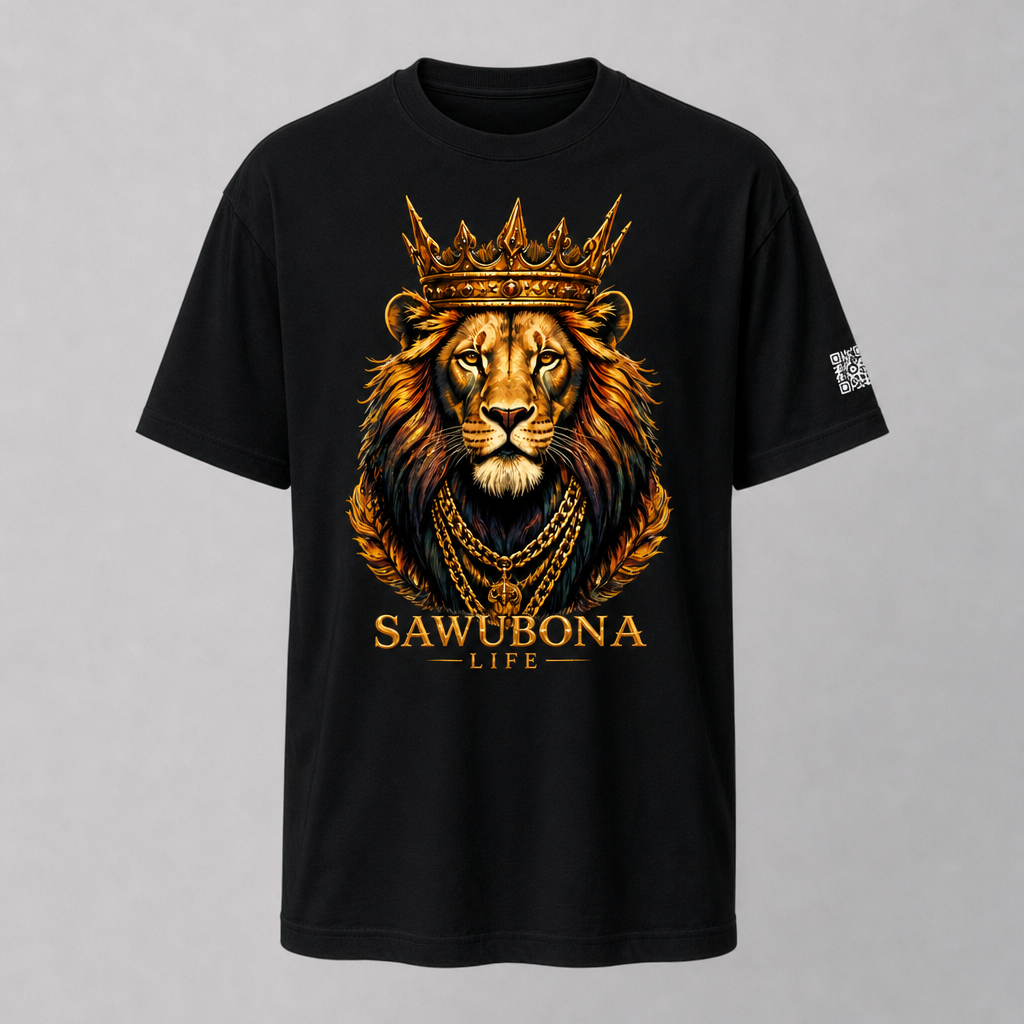
Crowned Lion 2 Black Unisex Graphic Tee from Sawubona Life
Quick Summary
A minimalist wardrobe for mindful living is a small, deliberate collection of clothes chosen to honor how you actually feel rather than how trends tell you to look. Most people land between thirty and fifty pieces total, and the right number is the one where you wear nearly everything you own.
Set aside two hours, pull everything out, and sort in passes rather than deciding everything at once.
A workable starting framework is 5-6 tops, 3-4 bottoms, 2 outerwear pieces, 2-3 shoes, and 2-3 accessories.
Run two seasonal swaps a year, in spring and fall, with smaller adjustments in midsummer and midwinter.
Cost-per-wear is the price of a garment divided by the number of times you wear it.
Adopt a one-in, one-out rule and schedule a short quarterly closet check-in.
What a Minimalist Wardrobe Means for Mindful Living
Sawubona. It's an isiZulu greeting that means "I see you," and it asks us to acknowledge a person's full worth before anything else. That same spirit sits at the heart of a minimalist wardrobe for mindful living: a small, deliberate collection of clothes chosen to honor how you actually feel, not how trends tell you to look. At Sawubona Life, we think of a minimalist wardrobe as less a style exercise and more a daily practice in self-recognition. What most guides miss is that the hard part isn't the closet. It's the mindset.
The Mindset Shift Behind Intentional Living
Intentional living is the practice of aligning everyday choices, including what you wear, with your values and your actual needs. It starts with a question: does this piece make my day easier or harder?
The shift is psychological before it's practical. A minimalist wardrobe asks you to stop buying for an imagined future self and start dressing the person you are today. If you want to go deeper into that philosophy, our guide on integrating intentional living with your daily wardrobe walks through how the mindset translates into real clothing decisions.
How Owning Less Clothing Reduces Daily Decision Fatigue
Fewer options mean fewer decisions, and fewer decisions leave more energy for everything else. A closet with twelve pieces you love asks one small question each morning instead of thirty. That reduction matters most for people managing sensory overload or chronic fatigue, where every extra choice draws from a limited reserve.
The Benefits of Owning Less Clothing
Owning less clothing pays back in time, money, and attention. A smaller wardrobe can make each piece easier to find, care for, and wear.
Less decision fatigue: a short rotation removes the morning debate.
Lower cost over time: fewer, better pieces spread their value across years of wear.
Easier maintenance: a smaller closet means simpler laundry and storage.
Clearer personal style: repetition reveals what you genuinely reach for.
Reduced textile waste: buying less keeps more fabric out of landfills.
The last point deserves more attention than it usually gets. The U.S. Environmental Protection Agency's textile waste data tracks how much clothing ends up discarded each year, and the numbers make a quiet case for buying deliberately rather than often.
How to Declutter Your Current Closet Step by Step
Decluttering works best as a structured process, not a single overwhelming afternoon. Set aside two hours, pull everything out, and sort in passes instead of deciding everything at once.
The Wardrobe Audit: Sorting With Intention
A wardrobe audit is a structured review of everything you own, judged against fit, comfort, and how often you actually wear it. Work through these steps:
Empty the entire closet onto the bed or floor.
Sort into three piles: keep, repair, release.
Try on anything you haven't worn in a year.
Set aside pieces that itch, pinch, or need constant adjusting.
Photograph the keep pile to see your real color palette.
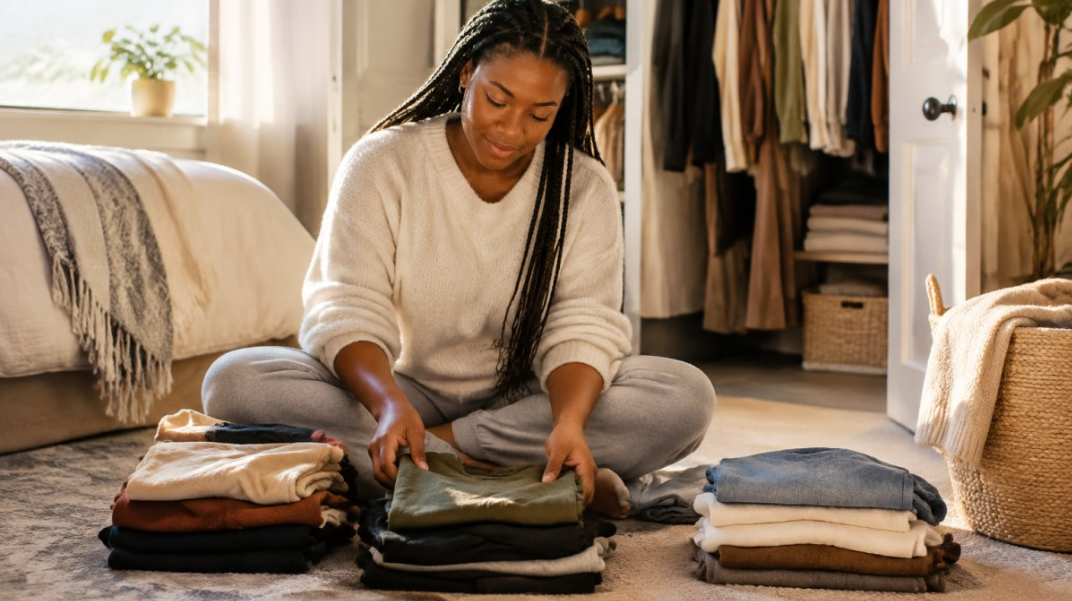
Woman Sitting on a Bedroom Floor Sorting Clothes into Piles to Build a Minimalist Wardrobe
What to Do with the Clothes You Remove
Resist the urge to bin everything. Consider selling what's in good condition, donating what's clean and wearable, and recycling worn-out textiles through a local collection program. Some pieces deserve a second life as repair projects. The goal is a decluttering process that keeps fabric in use rather than in a landfill.
Capsule Wardrobe Essentials for a Curated Collection
Capsule wardrobe essentials are the small set of versatile pieces that mix together to cover most of your week. A workable starting framework includes:
That's a capsule checklist you can adapt. The point isn't the exact count. It's choosing pieces that work together so outfit planning takes minutes.
How Many Items Belong in a Minimalist Wardrobe
There's no universal minimalist wardrobe number of items, and anyone who hands you a fixed figure is guessing. Most people land somewhere between thirty and fifty pieces total, counting everything from tops to outerwear.
The right number is the one where you wear nearly everything you own. If a third of your closet never leaves the hanger, you have room to trim. If you're constantly doing laundry to keep up, you've cut too far. Let your actual week set the number, not a blog post.
Essential Items for Every Season
A seasonal rotation keeps a minimalist closet functional year-round without bloating it. The idea is simple: you own a full year of clothing, but you only keep one season's worth within reach at a time. Store off-season pieces in bins or vacuum bags, and swap them in as temperatures shift.
What a Seasonal Rotation Actually Looks Like
Most people run two swaps a year, one in spring and one in fall, with a smaller adjustment in midsummer and midwinter for the pieces that only work in extreme heat or cold. The mechanics matter more than the calendar:
Pull out the outgoing season's pieces and wash or dry-clean everything before storage.
Store in breathable bins, not sealed plastic, so fibers don't trap moisture.
Bring in the incoming season and place it where you'll actually see it.
Do a quick audit as you swap: anything you didn't wear last season is a candidate for release.
Storing clothes damp or in sealed plastic can invite mildew, so let pieces air dry fully before storage.
Warm-Weather Essentials
For warmer months, lean on breathable cotton tees, one light layer, and a versatile bottom. A workable warm-season core is three to four tops, two bottoms, one light outer layer for air-conditioned offices, and one pair of comfortable shoes that works for both casual and smart-casual days. Light colors reflect heat; loose weaves breathe better than tight knits.
Cold-Weather Essentials
For colder months, add a warm outer layer, a long-sleeve base, and closed shoes. The cold-season core is two to three long-sleeve bases, one mid-layer such as a sweater or fleece, one insulated outer layer, and one pair of weather-appropriate shoes. Layering beats bulk: a thin base plus a mid-layer plus a shell handles more temperature ranges than one heavy coat.

A Woman Wearing the Crowned Lioness 2 Black Unisex Long-Sleeve Tee from Sawubona Life
The Overlap Strategy
The trick is overlap: choose colors and cuts that work across seasons so fewer pieces do more work. A neutral palette of two or three core colors lets a warm-season top pair with a cold-season layer without clashing. Versatility beats volume every time, and a piece that works in three seasons earns its place more than one that works in one.
Transition Pieces That Do Double Duty
The pieces that survive every swap are the ones worth investing in: a light merino or cotton cardigan, a pair of dark straight-leg trousers, a plain white or cream tee, and a pair of closed-toe shoes that read clean in any season. These are the anchors that let a small closet cover a full year without a second wardrobe.
Choosing Quality Over Quantity
Quality over quantity is the financial argument that makes minimalism stick. One well-made piece that lasts several years usually costs less per wear than three cheap ones that pill and fade.
Look for sturdy seams, honest fabric content, and construction that survives repeated washing. A common mistake is judging quality by price alone. A mid-priced cotton tee with tight stitching often outlasts a designer piece with loose hems.
Cost-Per-Wear: The Only Math That Matters
Cost-per-wear is the price of a garment divided by the number of times you wear it. A $40 tee worn weekly for two years costs pennies per wear. A $15 tee worn twice costs far more. Run that math before any purchase, and the cheap option rarely wins.
Mindful Fashion Practices for Conscious Shopping
Mindful fashion practices start before checkout. Ask three questions: do I need this, will I wear it at least thirty times, and does it fit the palette I already own?
Conscious shopping also means knowing who made your clothes and what they stand for. If you want a practical starting point, our guide on shopping Black-owned mindful apparel shows how to find brands whose values match your own. Buying less, and buying from makers you trust, is the whole game.
Sustainable Fashion and the Environmental Impact of Textile Waste
Sustainable fashion matters most at the point of disposal, and that's where the environmental case gets uncomfortable. The U.S. Environmental Protection Agency's textile waste data tracks how much clothing and footwear ends up in the municipal solid waste stream each year, and the pattern is consistent: generation has climbed for decades while the share recovered for reuse or recycling has stayed small. Most of what leaves a closet arrives at a landfill or incinerator, not a second wearer.
The Ellen MacArthur Foundation's work on circular fashion has documented how much clothing is produced and discarded each year globally, much of it worn only briefly. Put the two pictures together and the mechanism becomes clear: every garment you keep in rotation for another year is one that doesn't become waste, and every garment you never needed is waste created at the point of purchase, before it ever hangs in a closet.
Slow fashion is the practical response, and it works through three levers:
Buy fewer pieces. The most effective environmental decision happens before checkout, not at the donation bin.
Choose materials that last. Dense cotton, wool, and linen hold up to repeated washing better than loose knits and thin blends.
Repair before replacing. A mended seam or reattached button keeps a garment in use for months or years longer.
Watch out: Donation is not the same as recycling. Many donated garments are exported or downcycled rather than being re-worn, so 'I'll just donate it' is not an environmental plan. The plan is to buy less in the first place.
A smaller wardrobe also changes the secondhand math. When you keep only pieces you genuinely wear, the items you do release are more likely to be in good enough condition to be resold or passed on, which keeps fabric in use rather than in the waste stream. That's not a slogan. It's arithmetic you can run on your own closet.
Sensory-Friendly Clothing for Neurodivergent Wardrobes
For neurodivergent adults, a minimalist wardrobe isn't just tidy. It's a comfort system. Tags, rough seams, and stiff fabric can turn getting dressed into a daily battle, and removing those irritants matters more than any aesthetic.
Sensory-friendly clothing prioritizes soft fabric, flat seams, and tagless construction so the body isn't constantly negotiating with the garment. A smaller closet of genuinely comfortable pieces also reduces the guesswork: you know each item feels right because you've already vetted it.
Close-Up of Flat Seams from a Sawubona Life Hoodie
Tagless, Ultra-Soft Basics That Respect Sensory Needs
This is where Sawubona Life does its work. Our premium, ultra-soft, tagless apparel is designed so nothing scratches, rubs, or demands adjustment. Before you buy, our guide on shopping tagless clothing for sensitive skin explains which fabrics, seams, and fits to compare. If you're weighing whether the investment pays off, read whether sensory-friendly clothes are worth it for a clear look at costs, benefits, and fabrics.
Capsule Wardrobes for Different Body Types and Shapes
A capsule built for someone else's frame will never feel like yours. Build around your actual proportions: if you're tall, prioritize tops with enough length; if you're broad-shouldered, choose cuts that don't pull across the back.
Fit is the deciding factor, not the size on the label. Try pieces on, move in them, and keep only what stays comfortable through a full day. A customer named T. Avon noted that finding shirts that fit a wider build can be a challenge, and said Sawubona Life "got me covered." That's the standard to hold every piece to.
Repair and Garment Care for Garment Longevity
Garment longevity comes down to a few habits that most people skip. Wash less often, in cold water, and air-dry when you can. Turn knits inside out, use a mesh bag for delicates, and learn a basic stitch for hems and buttons.
A small repair kit pays for itself quickly. Reattaching a button or mending a seam takes minutes and adds months of wear. Clothing maintenance is the least glamorous part of minimalism and the most effective.
Workplace-Specific Minimalist Capsules
A work capsule solves a specific problem: looking put-together five days a week from a handful of pieces. Start with two or three bottoms and four tops in a unified color palette, then add one layer for temperature swings.
If your workplace leans casual, prioritize soft basics that transition from desk to weekend. If it's more formal, invest in structured pieces you can rotate. Either way, keep the palette tight so everything pairs without thought.
Maintaining a Minimalist Closet Long-Term
Wardrobe organization keeps a capsule from quietly expanding back into clutter. Adopt a one-in, one-out rule. Review your closet each season and pull anything you haven't worn. Keep a running list of gaps so you buy with purpose instead of impulse.
The capsule system only holds if you maintain it. Schedule a short quarterly check-in, repair what's worn, and release what no longer fits your life. Mindful consumption is a habit, not a one-time purge.
Start Your Mindful Wardrobe with Sawubona Life
Building a minimalist wardrobe asks you to see yourself clearly, and that's exactly where Sawubona begins. If you're ready to dress with intention, Sawubona Life makes it easier with premium, ultra-soft, tagless apparel, subtle sleeve QR codes for quiet advocacy, and mindfulness digital tools that turn getting dressed into a moment of self-recognition. Get started with Sawubona Life and build a wardrobe that honors your comfort, your identity, and your peace.
Frequently Asked Questions
What is the 3-3-3 rule for a minimalist wardrobe?
The 3-3-3 rule is a starting framework: dress from three colors, build around three core silhouettes, and limit yourself to three pieces per category as you begin. It works as a training wheel for intentional living, not a permanent cap. Once you see how few pieces you actually reach for, you can expand the capsule wardrobe to fit your real life, climate, and sensory needs rather than a rigid number.
How does a minimalist wardrobe support mental health and mindful living?
Fewer options mean fewer daily decisions, which matters for anyone managing sensory overload or chronic illness. A curated collection also removes the guilt of unworn clothes and the low-grade stress of a cluttered closet. When every piece fits well and feels good against your skin, getting dressed becomes a calm ritual instead of a negotiation. That is the core of mindful fashion practices: less noise, more intention.
What is the difference between a capsule wardrobe and a minimalist wardrobe?
A capsule wardrobe is a seasonal rotation of a set number of interchangeable pieces. A minimalist wardrobe is the broader philosophy of owning only what you wear and love. You can run a capsule system inside a minimalist wardrobe, swapping seasonal items in and out while keeping the total count low. Think of the capsule as the method and minimalism as the mindset behind it.
How many items should a minimalist wardrobe have?
There is no universal number of items for a minimalist wardrobe. Common starting points range from about 30 to 50 pieces, including shoes, but the right count depends on your climate, laundry habits, work dress code, and sensory preferences. A better test than a number: if you wore every item in the last month without stress, your wardrobe is working. Adjust from there rather than chasing a figure.
How do I transition to a minimalist wardrobe without feeling restricted?
Start with a wardrobe audit, not a purge. Pull out what you wore in the past 30 days and build around those pieces first. Keep a small bin of maybes for 60 days before deciding. Add capsule wardrobe essentials slowly, choosing versatile staples you can mix. The goal is a curated collection that feels like enough, not deprivation, so leave room for the pieces that genuinely bring you comfort and confidence.
What should I look for in sensory-friendly clothing for a minimalist wardrobe?
Prioritize tagless construction, soft seams, and breathable fabrics like cotton that do not irritate skin. Check the exact material and weight before buying, and confirm the return policy in case the feel is wrong. Sawubona Life offers ultra-soft, tagless apparel, and customer T. Avon has described shirts that feel comfortable for sensitive skin and fit a wider build. Fit and fabric matter more than trend when sensory comfort is the priority.
The Bottom Line
Your closet can hold fewer pieces and still say more about who you are. Start with one drawer, one honest audit, and one piece that genuinely feels good against your skin. Browse the Sawubona Life collection and take the first step toward a wardrobe that sees you back.
PRIORITIZE A DELIBERATE WARDROBE.
DRESS WITH INTENTION.
HONOR AND WEAR YOUR TRUTH.
