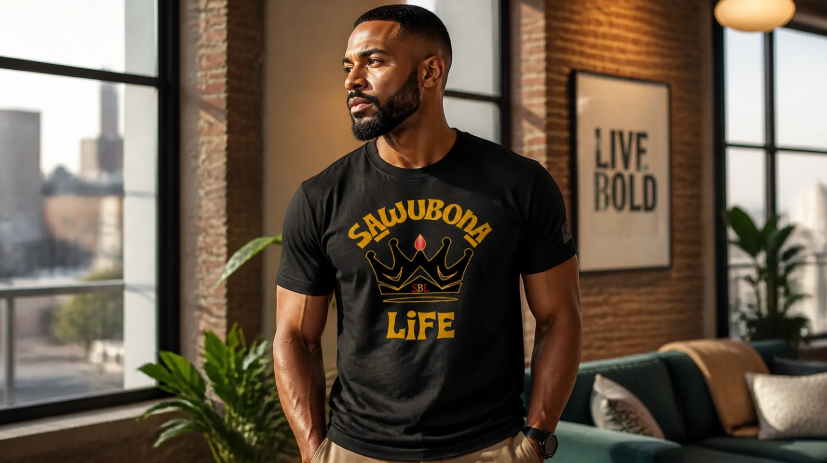
An African-American Man, Standing in a Well Lit and Comfortable Living Room, Wearing the Sawubona Life Crown Unisex Graphic Tee
Why Sensory Friendly Clothing Changes Daily Life
Sawubona. It means "I see you," and it is the right place to start, because what makes clothing sensory-friendly for autism begins with being seen: your nervous system, your preferences, your body, exactly as they are.
Sensory-friendly clothing is apparel designed to reduce tactile, thermal, and structural irritation so the wearer can move through the day without their clothes demanding attention.
That matters because clothing is the one sensory input you cannot take a break from. You can leave a loud room. You cannot step out of your shirt at 2 p.m.
Below, we break down what actually makes clothing sensory friendly for autism, fabric by fabric, seam by seam, plus a home assessment you can run this week.
How Clothing Sensitivities Affect Autistic People
Clothing sensitivity is a difference in how the nervous system registers and filters touch, and it can run in either direction: some people feel fabric, seams, and labels far more intensely than others, while some register them barely at all. Both are real, and both shape what a person can comfortably wear.
The National Institute on Deafness and Other Communication Disorders and other federal health resources describe sensory processing differences as a recognized part of the autistic experience. In daily life, that shows up in specific ways:
A waistband that feels fine at 8 a.m. becomes unbearable by noon
A single scratchy tag can hijack focus for an entire meeting
Certain textures trigger immediate, whole-body rejection
Getting dressed can become a daily negotiation or a source of dread
The practical cost is easy to underestimate. When clothing competes for attention, focus, self-regulation, and independence all take the hit. A comfortable shirt is not a small thing. It is infrastructure.
Common Sensory Triggers in Everyday Clothing
Most sensory triggers hide in plain sight, in garments people without sensitivities never think twice about. Here are the usual suspects:
Tags and labels at the neck and waist, especially stiff woven ones
Rough seams and overlocked stitching that rubs against your skin
Scratchy fabric blends, particularly wool and stiff synthetics
Tight waistbands, cuffs, and collars that create constant pressure
Heavy zippers, buttons, and hardware that add weight and contact points
Synthetic linings that trap heat and moisture
Loose threads and embroidery backing on the inside of a garment
A common mistake is buying a shirt that feels fine in the fitting room and fails by lunch. Texture softens or stiffens with body heat, sweat, and movement, so the real test happens after a few hours of wear, not thirty seconds in a mirror.
The Best Fabrics for Sensory Sensitivity
The best fabrics for sensory sensitivity share three traits: a smooth surface, breathability, and enough weight to drape without clinging. Fabric texture is the foundation of everything else, and no amount of clever design rescues a fabric that irritates on contact.
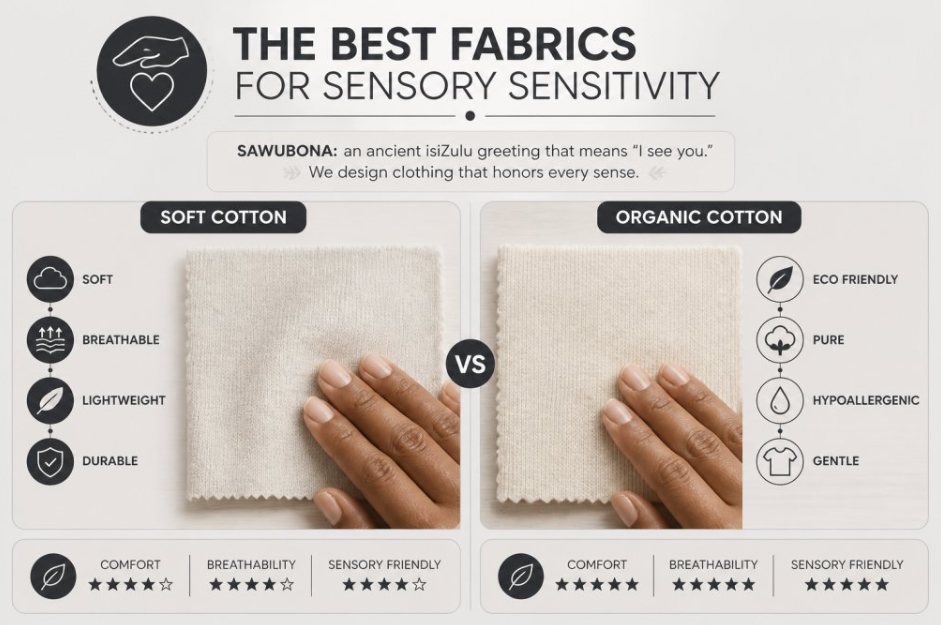
Close-up of Hands Touching Soft Cotton and Organic Cotton Fabric Swatches Laid Out on a Light Wooden Table, Showing Different Textures Side by Side
Natural Fibers: Cotton and Organic Cotton
Cotton is the workhorse of sensory friendly clothing, and for good reason. It breathes, it softens with washing, and it does not cling the way many synthetics do.
Look for combed or ring-spun cotton, which has a smoother hand than standard carded cotton. A mid-weight cotton jersey drapes without pressing against the body, while very thin cotton can feel flimsy and clingy. Weight matters as much as fiber.
Moisture-Wicking and Breathable Materials
Breathable materials matter more than most guides admit. Overheating is a sensory trigger in its own right, and damp fabric against skin can be worse than the heat that caused it.
Moisture-wicking fabrics move sweat away from the body, but quality varies enormously. Soft, brushed synthetics and bamboo blends can work well for active wearers, while stiff, shiny performance fabrics often fail the touch test. If you are choosing between two options, pick the one that feels smooth against the inside of your wrist, where skin is thin and sensitive.
Seams, Tags, and Stitching: The Small Details That Matter Most
Here is the part most guides get wrong: the fabric is only half the story.
Flat seams lie against the body without a raised ridge, which is why they matter so much in fitted garments. Overlocked seams, common in budget apparel, create a bulky, scratchy edge that rubs with every movement.
Stitching density counts too. Tight, dense stitching creates a stiffer seam; a slightly relaxed stitch feels softer against skin. And any embroidery or printed graphic should have a soft backing or none at all on the interior.
Tagless Clothing for Sensory Issues: What to Look For
Tagless clothing for sensory issues eliminates the neck label entirely, printing care information directly onto the fabric or moving it to an exterior location. It is one of the single highest-impact changes a garment can make.
When you shop for tagless clothing, check these five things:
Printed interior labels rather than woven tags, ideally with soft, cured ink
No secondary tags at the waistband or side seam, which many brands forget
Care information on the outside or on a removable card
Smooth interior printing that does not crack or stiffen after washing
Consistent quality across colors, since darker dyes sometimes change print texture
What most shoppers miss is that "tagless" often means only the neck tag is gone. Run your hand along the entire inside of the garment before buying. If you feel any raised label, it will find skin eventually.
Seamless Clothing for Sensory Sensitivities Explained
Seamless clothing for sensory sensitivities is constructed with minimal or bonded seams, often knit in a single piece so there is nothing to rub.
Seamless garments work best where fit matters most: underwear, base layers, leggings, and fitted tops. They reduce the pressure points that cause chafing and the ridges that become noticeable after an hour of wear.
Our honest take: seamless is worth prioritizing for anything worn directly against skin all day. For loose outer layers, well-placed flat seams do the job just as well.
Pro Tip: Turn the garment inside out and run the back of your hand along every seam before buying. Your hand is less sensitive than your torso, so anything you can feel with it will be far more noticeable once you are wearing the garment for hours.
Fit, Tightness, and Freedom of Movement
Fit is a sensory variable, not just a style one. A garment that is slightly too tight creates constant pressure signals; one that is too loose shifts, twists, and bunches, creating a different kind of irritation. The sweet spot is enough room to move without fabric migrating.
Freedom of movement matters especially for anyone who stims, fidgets, or changes posture frequently. Restrictive clothing can make self-regulation harder by adding physical constraint on top of everything else. Look for:
Drop shoulders or raglan sleeves that do not bind at the armhole
Elastic waistbands that sit flat rather than rolling or digging into your skin
Longer hem lengths that stay put when you sit, stand, or stretch
Fabric with a little stretch, so movement does not pull against seams
Sizing up is a common and reasonable strategy, but check that the larger size does not introduce new problems like gaping necklines or sleeves that slide.
Breathability and Temperature Comfort Through the Day
Temperature regulation and sensory comfort are the same conversation. A garment that traps heat creates sweat, sweat creates damp fabric, and damp fabric against skin becomes a sensory problem within minutes.
Layer with intention.
Time of day matters too. Many people find their sensitivity increases when they are tired, stressed, or overstimulated. A garment that worked at 8 a.m. may not work at 4 p.m.
Clothing Options for Children and Teens With Autism
For children and teens, clothing choices shape independence as much as comfort. A child who can dress themselves in clothing that feels good gains a daily win; a child who dreads getting dressed starts every morning at a disadvantage. But the needs shift fast across ages and settings, and a single checklist does not survive contact with a school week.
Match the garment to the setting, not just the age
Most guides treat "kids" as one category. In practice, the setting drives the requirement more than the birthday does.
School days. Prioritize quiet fabrics that do not rustle during silent reading, flat seams under a backpack strap, and closures the child can manage alone in a restroom stall. A pull-on waistband beats a button fly when fine motor time is tight.
Sleep. Look for tagless construction throughout, including the waistband, and breathable knits that do not trap heat. Avoid long cuffs that twist around the ankle overnight.
Physical activity and recess. Stretch fabric with flat-locked seams reduces chafing at the armhole and inner thigh. Check that shorts do not ride up, since a garment that migrates during play becomes a mid-recess problem.
Formal events. Scratchy dress shirts and stiff collars are common failure points. A soft knit polo or a cotton button-down with a relaxed collar preserves the look while removing the irritant. Test the full outfit, shoes included, a week before the event.
Transitions and travel. Layers help here: a breathable base layer plus a removable outer layer lets the child adjust without a full change.
Age-stage differences that actually change the purchase
Early childhood. Simple closures, soft stretch fabrics, and duplicates of the trusted shirt. Growth spurts mean fit changes every few months, so buy the same model in the next size up when it works.
Middle childhood. Peer awareness grows, so a sensory-friendly garment that looks like what classmates wear matters. Low-contrast, plain styles travel well across settings.
Teens. Fit, identity, and autonomy become part of the sensory equation. A teen may tolerate a slightly rougher fabric because it looks right, and that trade-off is theirs to make. Offer options within the comfort zone rather than deciding for them.
Involve the child in the decision
Being consulted about what touches your body is basic respect, and it builds self-advocacy skills that carry into adulthood. A practical way to do it:
Let the child rank the triggers. Ask which matters most: tags, seams, tightness, heat, or noise, and write the order down.
Offer two acceptable choices rather than an open-ended "what do you want," which can overwhelm.
Do the inside-out hand test together before buying, so the child learns the check rather than depending on an adult.
Respect the no. If a garment fails the wear test, believe the report instead of negotiating.
Watch Out: Do not buy a full new wardrobe based on one good day. Introduce one or two new garments at a time and wear-test them through a normal week, including a stressful one. A fabric that passes a calm Saturday can fail a busy Tuesday.
DO NOT IMPULSE SHOP.
HONOR YOUR NEEDS AND COMFORT.
DRESS WITH INTENTION.
Adaptive clothing for adults: Dignity and Independence
Adaptive clothing for adults is apparel designed to make dressing easier and more comfortable, often through modified closures, softer construction, and fits that accommodate different bodies and needs. It matters because sensory needs do not disappear at eighteen. But most adaptive-clothing content treats the adult as a patient to be managed rather than a person with preferences, and that is the gap worth closing.
Features that earn their place, and their trade-offs
Pull-on styles reduce the effort of dressing. Trade-off: some pull-on waistbands roll or dig after a few hours, so check that the band sits flat when seated.
Flat, soft waistbands avoid pressure on tender areas. Trade-off: very wide bands can feel like compression to someone who dislikes pressure.
Tagless construction throughout, not just at the neck. Trade-off: printed interior labels can crack after repeated washing, so inspect them periodically.
Fabric with “give” accommodates swelling, stiffness, or a limited range of motion. Trade-off: high-stretch knits can cling, which is its own sensory problem for some wearers.
Closures placed where the wearer can reach them, magnetic snaps, larger pulls, or side openings, matter more than the label "adaptive."
Designs that look like ordinary clothing, because dignity is part of the feature set. A garment should not signal "medical" or "different."
Center the wearer's preference, not the caregiver's assumption
The most common failure in adaptive clothing is a well-meaning adult choosing for the autistic adult. Preference is data. A few practices that keep the wearer in charge:
Ask before adapting. Removing a tag or altering a seam changes a garment that the person may have chosen deliberately.
Let the person define "comfortable." Some prefer gentle compression; others find any pressure intolerable. Neither is wrong.
Respect the no. If a garment fails the wear test, believe the report rather than renegotiating.
Build a personal specification. A short written note of fabrics, fits, and features that work turns every future purchase into a match rather than a gamble.
Across settings and life stages
Work. Quiet fabrics that do not rustle in a shared office, flat seams under a bag strap, and layers that can be shed when a meeting room runs warm.
Formal events. A soft knit blazer or a cotton button-down with a relaxed collar preserves the look while removing the irritant. Test the full outfit, shoes included, before the day.
Exercise. Flat-locked seams and stretch fabric reduce chafing; check that hems stay put during movement.
Sleep and recovery days. Breathable knits, tagless throughout, and a waistband that does not press when lying down.
Key Takeaway: Adaptive clothing is not a category of garment. It is a match between a specific person's sensory profile and the settings they actually move through, and the person, not the caregiver, is the authority on that match.
Sensory Preferences Beyond Touch: Sound, Weight, and Visual Calm
Touch gets most of the attention, but sensory preferences extend well beyond fabric. Sound, weight, and visual calm all shape whether a garment feels wearable.
Sound matters more than people expect.
Weight is a genuine preference axis. Some people find gentle compression or a heavier fabric calming; others find weight oppressive and need light, airy garments.
Visual calm counts too. Busy prints, high-contrast graphics, and reflective details can add visual noise.
Key Takeaway: Sensory-friendly is not one specification. It is a personal profile of touch, sound, weight, and visual preferences, and the best clothing matches that specific profile rather than a generic checklist.
A Practical Clothing Assessment You Can Do at Home
An individualized assessment beats any generic shopping list, because your sensory profile is yours.
Step 1: Audit what you already wear. [Time: 20 minutes] Pull out the five garments you reach for most.
Step 2: Identify your failure patterns. [Time: 15 minutes] Look at the clothes you avoid. What do they have in common?
Step 4: Wear-test one variable at a time. [Time: one full day] Change one thing per test, so you know what actually made the difference.
Step 5: Record and repeat. [Time: ongoing] Keep a short note of what worked.
Care, Washing, and Making Sensory-Friendly Clothing Last
Care practices change how a garment feels, and this is where many good purchases quietly go bad.
Wash sensory-friendly clothing inside out in cool water with a gentle, fragrance-free detergent. Skip fabric softener, which leaves a residue that can alter texture and irritate sensitive skin.
Check printed interior labels periodically. If a tagless print begins to crack or lift, that edge will start to catch on skin.
Durability is part of sensory value. A shirt that feels perfect for three washes and then stiffens was not a good buy.
Budget Tips: Adapting Existing Clothes and Shopping Smart
You do not need to replace a wardrobe to make it more sensory-friendly. Adaptation is often the cheapest and fastest route.
Cut out tags carefully with small scissors, leaving a soft stub rather than a sharp corner
Wear garments inside out when seams are the problem, which is free and immediate
Add a soft base layer under rough outer garments
Replace tight elastic with a looser drawstring or a wider, softer band
Buy duplicates of the one garment that works, rather than experimenting widely
When shopping, prioritize fewer, better pieces. A single well-made tagless shirt that you wear three times a week beats five cheap ones that irritate.
We built Sawubona Life around this exact problem: premium, ultra-soft, tagless apparel designed to honor sensory comfort, from a Black, women-owned business. Our tees carry subtle sleeve QR codes for quiet advocacy, so the garment supports your mental health journey without announcing it to anyone else.
Frequently Asked Questions
What makes clothing sensory-friendly for autism?
Sensory-friendly clothing for autism combines soft, breathable fabrics with construction details that reduce irritation. That means flat seams or no seams at all, tagless necklines, and a fit that allows freedom of movement without tightness. The goal is to remove the small daily triggers, like scratchy labels or rough stitching, that pull attention away from focus and self-regulation. Fabric texture, weight, and breathability all matter, and the right combination varies from person to person.
What are the best fabrics for sensory sensitivity?
Cotton and organic cotton are common starting points because they feel soft against the skin and breathe well. Moisture-wicking fabrics help with temperature comfort and reduce the damp, clammy feeling that can trigger sensory discomfort. Avoid rough wool blends, stiff denim, and synthetic fabrics with scratchy textures unless the wearer specifically prefers them. The best fabric is the one the person actually tolerates, so test small pieces before committing to a full wardrobe.
Are tagless clothes better for people with sensory sensitivities?
For many autistic people, yes. Traditional tags and labels sit directly against the neck and back, creating a constant itchy, irritating sensation that is hard to ignore. Tagless clothing for sensory issues prints care information directly on the fabric or moves it to an exterior location, removing that trigger entirely. If a garment still has a tag, cutting it out carefully or sewing fabric over it can help, though printed labels are the more reliable solution.
How can I make everyday clothes more comfortable for sensory sensitivities?
Start by identifying the specific triggers: seams, tags, tightness, fabric texture, or temperature. Wash new clothes before wearing to soften the fabric. Remove tags and consider wearing a soft base layer under rougher garments. Choose seamless clothing for sensory sensitivities where possible, and size up if tightness is an issue. A short trial period at home, before wearing something for a full day, helps you learn what works without the pressure of being out in public.
What clothing features can bother autistic adults?
Common irritants include scratchy tags and labels, thick or raised seams, tight waistbands and cuffs, rough stitching, stiff collars, and fabrics that trap heat or moisture. Button closures, zippers, and decorative elements can also create pressure points or distracting sounds. Because sensory processing varies, an adult may be fine with one feature and deeply bothered by another, which is why an individualized assessment is more useful than a generic checklist.
What should I look for when choosing sensory-friendly clothing?
Look for soft, breathable fabrics like cotton, flat or seamless construction, tagless necklines, and a relaxed fit that allows movement. Check the fabric weight if you have temperature sensitivities, and confirm the return policy before buying, since the feel of clothing can be difficult to judge online. Involving the wearer in the choice matters too, especially for adults who want adaptive clothing that supports independence rather than replacing it.
The Bottom Line: Honor Sensory Comfort
Getting dressed should not be the hardest part of your morning. When shopping, prioritize fewer, better pieces. A single well-made tagless shirt that you wear three times a week beats five cheap ones that irritate.
If you are tired of compromising between comfort and clothes that feel like yours, Sawubona Life makes ultra-soft, tagless apparel with the details that matter: smooth fabric, no irritating labels, and a fit that respects your body. Explore the collection and find the pieces that let you move through your day seen, comfortable, and at ease.
WE SEE YOU.
WE VALUE YOU.
YOUR COMFORT IS A PRIORITY.